

Amaris 500E Excimer Laser (Sshwind, Germany)
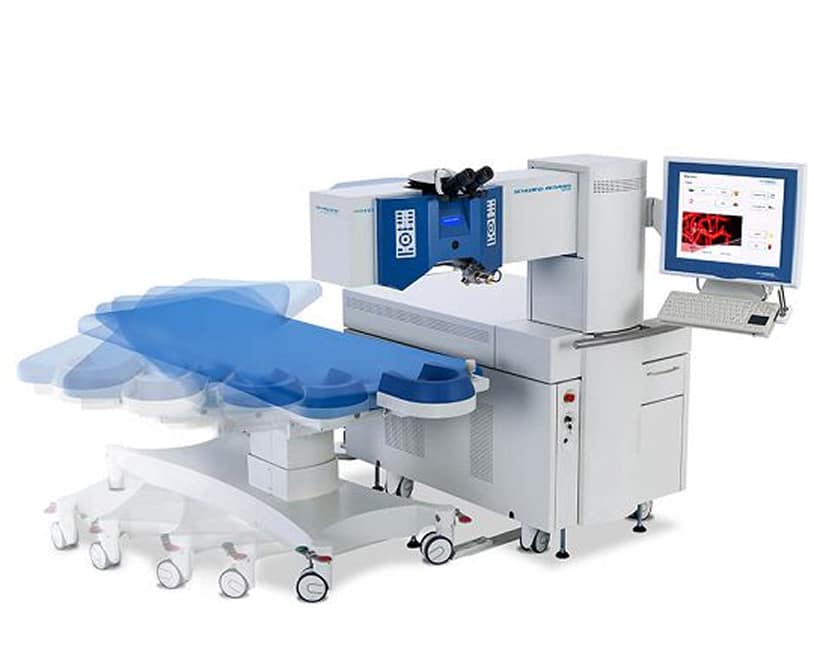
The Sсhwind Amaris 500E excimer laser embodies state-of-the-art technological innovations for laser vision correction systems. Numerous clinical studies have confirmed the high efficiency and safety of Amaris 500E to improve visual acuity and quality in patients with various forms of myopia, hyperopia, astigmatism, and high-order aberrations (refractive distortions). Automatic Fluence Level Adjustment “AFLA” provides an optimal correlation between several laser pulses and the laser energy delivered to the tissue, resulting in quick ablation with optimal corneal topography alignment. The laser system with a 500 Hz laser pulse repetition rate is efficiently supplemented with a 5D eyetracker, which compensates for micro-movements of the eye in five dimensions. You will get better quality of correction. The procedure will be safe, and rehabilitation will be quick.
WaveLight® EX500 excimer laser

WaveLight® EX500 makes laser correction extremely safe and rehabilitation afterward is fast and comfortable.
The multidimensional eye tracker registers the position of the eye at a frequency of 1050 Hz with a response delay of just 2 milliseconds — 10 times faster than the eye itself can move.
The laser beam acts on the cornea with maximum precision, and thanks to “cold beam” technology, the corneal tissue is not subjected to thermal impact. does not affect your everyday routine: there’s no need to take time off work or be hospitalized. Just a few days after the procedure at the , you can comfortably work on a computer, read, write, and watch television.
IntraLase FS60 femtosecond laser (USA)
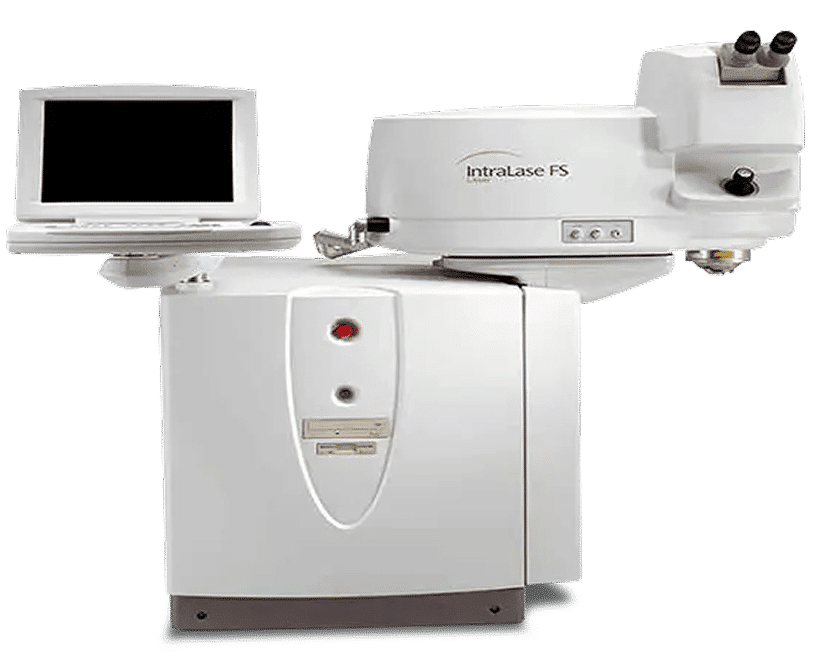
A femtosecond laser is used to perform excimer laser correction according to a revolutionary femtosecond laser technique. During femtosecond laser vision correction, a corneal flap is created not with a microkeratome but with a femtosecond laser beam, i.e., it is absolutely contact-free. The IntraLase FS60 femtosecond laser has a high frequency and short pulse duration. Pulse duration is measured in femtoseconds (a trillionth of a second, 10-15 seconds), which allows separating corneal layers at the molecular level without heat emission and mechanical effect on surrounding eye tissues. The femtosecond laser beams are focused at a given depth with an accuracy of up to several microns to create a microbubble layer of the desired configuration. By positioning multiple microbubbles adjacent to each other using a computer-controlled program, the eye surgeon can obtain a splitting plane of absolutely any shape with the utmost precision.
Corneal flap formed during femtosecond laser correction is uniform in thickness, is thin, and has smooth borders. The constant thickness of the corneal flap excludes high-order aberrations due to the effect of inhomogeneous beam refraction, increasing safe procedure and dramatically reducing the rehabilitation period. The perfectly smooth surface of the corneal tissue delamination border enables to achieve a significant reduction of rehabilitation period and preserve high contrast sensitivity.
The IntraLase FS60 femtosecond laser is part of the completed iLasik product line. It works together with Amaris 500E excimer laser and WaveScan aberrometer. This complex makes it possible to perform laser vision correction, considering the slightest peculiarities of the patient’s visual system.
Wavelight® Topolyzer VARIO™ (Alcon, США)

WaveLight® Topolyzer VARIO™ is a modern diagnostic system designed for detailed examination of the corneal surface before laser vision correction. The device performs non-contact corneal topography and keratometry, allowing the ophthalmologist to assess the shape, curvature, and individual characteristics of the cornea.
During the examination, the system analyzes up to 22,000 data points, creating a detailed topographic map of the cornea. This type of diagnostics helps detect even minor irregularities and individual features of the corneal surface that are important to consider when planning laser vision correction.
Data obtained with Topolyzer VARIO™ can be used for laser vision correction planning and transferred to the WaveLight® EX500 excimer laser system. This makes it possible to plan the laser treatment based on the individual topography of each patient’s cornea.
At the Eximer Medical Center in Odesa, WaveLight® Topolyzer VARIO™ and WaveLight® EX500 work together as an integrated technological system for diagnostics and laser vision correction.
The Moria Evolution 3 Microkeratome
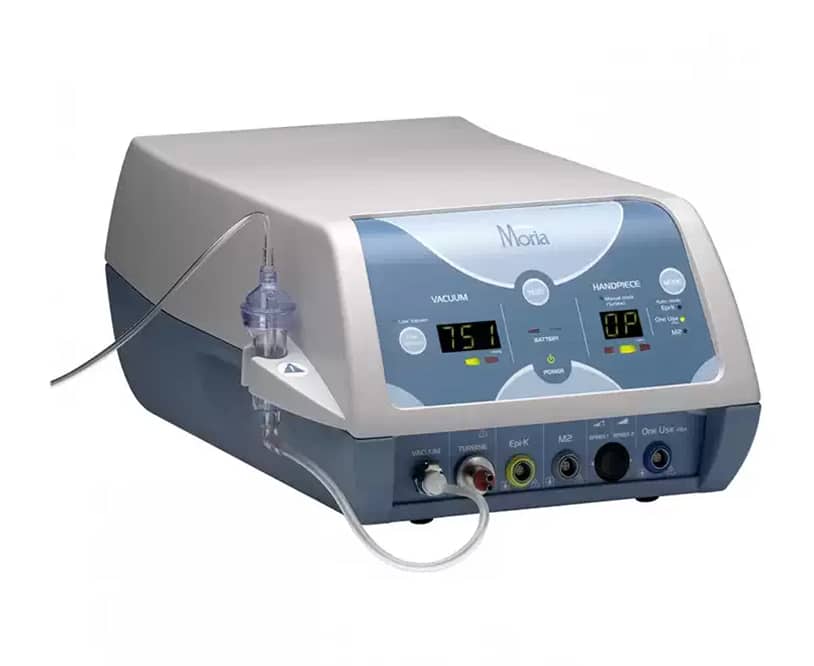
The result of excimer laser correction depends not only on the laser but also on such an important device as a microkeratome. It is needed to perform excimer laser correction by the most popular LASIK technique, which involves treating the inner cornea rather than the outer cornea layers. Eximer Ophthalmology Clinic employs a microkeratome by the world-renowned Moria Company. The design of the microkeratome rings provides for flexible adjustment of the equipment to the individual characteristics of a patient’s eye, thus making it possible to achieve precise correction results and the required visual characteristics.
SCHWIND SIRIUS+ (SCHWIND)

SCHWIND SIRIUS+ (Germany) is a modern corneal topography system designed for comprehensive examination of the cornea and the anterior segment of the eye. The system combines Placido-disc-based topography with three-dimensional scanning using a Scheimpflug camera, providing detailed information about the condition of the cornea in a single examination.
SCHWIND SIRIUS+ analyzes the shape, curvature, and refractive power of the cornea, evaluates its thickness as well as its anterior and posterior surfaces, and generates topographic, elevation, and pachymetric maps. The data obtained help the ophthalmologist identify individual corneal characteristics and possible changes that should be considered when selecting a vision correction method.
This type of diagnostics is particularly important when preparing for laser vision correction. Detailed corneal parameters help determine whether the procedure can be safely performed and allow the laser treatment to be planned individually for each patient.
At the Eximer Medical Center in Kyiv, SCHWIND SIRIUS+ is used in combination with the SCHWIND AMARIS 500E excimer laser, providing precise diagnostics and a personalized approach to laser vision correction planning.