
Super LASEK laser vision correction – is a reliable way to achieve good eyesight and say goodbye to glasses and contact lenses for good. For many years, Excimer Clinic (Odesa) has offered the most advanced and gentle excimer laser correction techniques, among which Super LASEK holds a special place — a method developed specifically for patients with thin or non-standard corneas. The correction technique is always selected individually, based on medical indications and a full diagnostic examination of the patient’s visual system. The results of this diagnosis also determine the cost of the procedure.
Super LASEK Laser Vision Correction
Super LASEK (LASEK — Laser Epithelial Keratomileusis) is an advanced, non-contact excimer laser correction technique in which the laser acts directly on the surface layers of the cornea, without creating a deep corneal flap. This gentle, safe, and predictable procedure is especially recommended for people with thin corneas, an active lifestyle, or professional restrictions on the use of a microkeratome.
The essence of excimer laser correction is changing the refractive power of the cornea by giving it a new, precisely calculated shape using laser radiation, so that light rays focus exactly on the retina.
How Does the Laser Reshape the Corneal Surface?
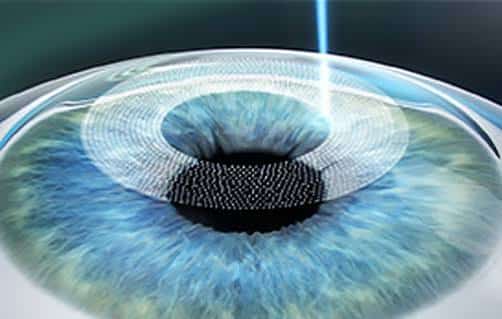
Laser vision correction is based on the phenomenon of photoablation — the process by which tissue transitions from a solid to a gaseous state under the effect of light. The excimer laser’s radiation forms a diatomic gas molecule in an excited and extremely unstable state. This molecule exists for an infinitesimally short time — thousandths of a second — before decaying and releasing a light wave in the ultraviolet range. This radiation, acting on the corneal tissue, breaks intermolecular bonds, causing part of the tissue to evaporate.
The photoablation process does not involve heating of the surrounding tissue, so no “burning” of the cornea occurs during correction. Each laser pulse removes a layer just 0.25 microns thick — about 1/500 of the thickness of a human hair. This precision allows the laser to shape an ideal, pre-calculated corneal surface, making it possible to correct virtually any type and degree of refractive error.
Features of the Super LASEK Method
During Super LASEK correction, the surgeon does not create a deep corneal flap using a microkeratome, as is done in LASIK. Instead, a special solution is used to separate and gently move aside only the thinnest surface layer — the epithelium — after which the laser acts directly on the surface of the corneal stroma. Once the laser treatment is complete, the epithelial layer is repositioned and protected with a special soft contact lens, which is removed a few days after the procedure.
This approach makes it possible to perform vision correction:
even when the cornea is relatively thin, reduces the risk of complications associated with creating and displacing a deep flap, makes the technique particularly suitable for people whose life or profession involves an increased risk of eye injury: athletes, military personnel, and law enforcement officers.
Advantages of Super LASEK Laser Vision Correction:
- preserves the maximum thickness and strength of the cornea;
- minimal risk of complications associated with a corneal flap;
- enables correction even with a thin or non-standard cornea;
- stable, highly predictable results; safe for contact sports in the future;
- wide range of application: nearsightedness up to -15, farsightedness up to +6, and astigmatism.
Results of Laser Vision Correction
Super LASEK laser vision correction allows for effective and safe correction of nearsightedness, farsightedness, and astigmatism without significant restrictions afterward. As a result of the procedure, a person gains not only high-quality vision but also complete freedom from glasses and contact lenses and all the inconveniences associated with wearing them.
Unlike LASIK, vision after Super LASEK recovers somewhat more gradually — a characteristic of the technique related to the healing of the epithelial layer. For the first few days after surgery, the patient wears a protective contact lens, and final visual acuity develops over the following days. This feature is fully offset by the added strength and long-term safety of the cornea.
Equipment for Super LASEK Laser Vision Correction
Super LASEK vision correction at the Excimer ophthalmology center (Odesa) is performed using the latest-generation WaveLight® EX500 excimer laser.
WaveLight® EX500 is one of the fastest laser systems in the world, making the vision correction procedure as safe, precise, and comfortable as possible for the patient. The laser operates at speeds of up to 500 pulses per second, allowing corneal ablation to be completed in a matter of seconds and significantly reducing the exposure time to the eye. The laser is equipped with a high-speed eye-tracking system that monitors the position of the eyeball at a rate of 1,050 frames per second and instantly compensates for the slightest involuntary eye movements, including rotation (cyclotorsion). Thanks to Perfect Pulse Technology, each laser pulse is delivered with micron-level precision, ensuring an exceptionally smooth and even corneal surface after correction. The laser’s advanced software takes each patient’s individual characteristics into account and selects the optimal ablation profile, ensuring an excellent result regardless of case complexity.
Facts About the Super LASEK
Method The Super LASEK technique does not require the creation of a deep corneal flap, making it one of the gentlest methods in terms of preserving corneal structure. More than 95% of patients who underwent Super LASEK vision correction report high-quality vision and recommend the procedure to family and friends. The entire procedure takes 10-15 minutes (both eyes). The technique is especially popular among people with an active lifestyle and those involved in contact sports.